Abdominal & Thoracoabdominal Aorta
Fenestrated & Branched EVAR (FB-EVAR)
Custom stent-grafts for complex and thoracoabdominal aneurysms.
Overview
What it is
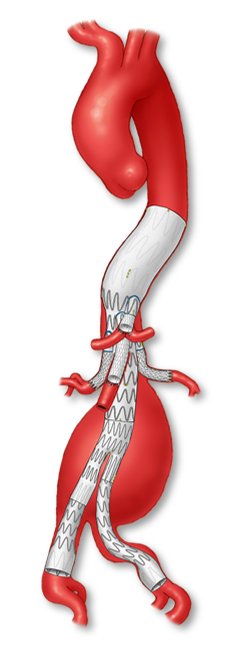
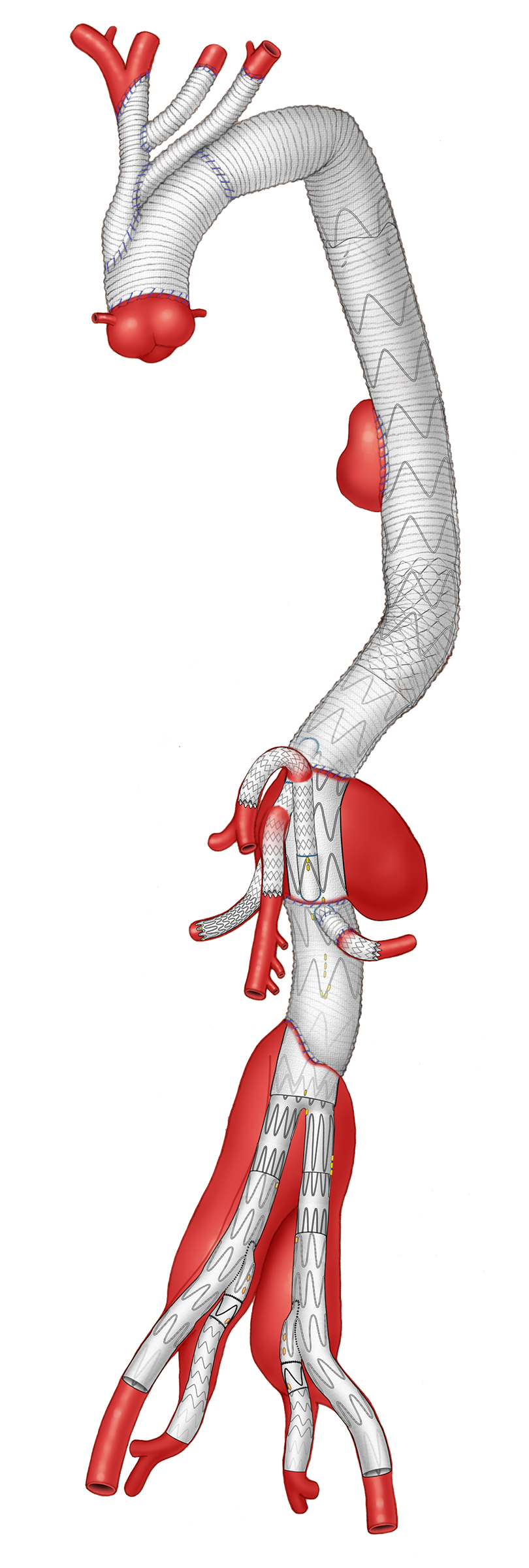
FB-EVAR is a minimally invasive solution for complex and thoracoabdominal aneurysms that sit too close to the arteries supplying the kidneys, intestines, and liver. Custom stent-grafts with small openings (fenestrations) or side branches preserve blood flow to those organs while sealing off the aneurysm — avoiding the large incision of open surgery.
When it’s recommended
- Complex (juxtarenal/pararenal) and thoracoabdominal aneurysms
- Patients who benefit from a minimally invasive approach
- Anatomy involving the renal and visceral arteries
How it’s performed
Every plan is individualized and reviewed by our multidisciplinary aortic team.
High-resolution imaging to design a patient-specific device
Custom fenestrations/branches are planned for each artery
The graft is delivered endovascularly and aligned to the branches
Branch vessels are stented to preserve organ blood flow
Recovery
Recovery & follow-up
Recovery is generally faster than open repair, with a short hospital stay; because durability depends on the device, structured lifelong surveillance imaging is essential.
How the technique evolved
Fenestrated and branched stent-grafts were pioneered in the early 2000s and have been refined over more than two decades of device engineering and technique. What once required major open surgery can now, in suitable patients, be treated through small punctures in the groin — extending minimally invasive repair to the most complex aortic aneurysms, including those involving the branches to the kidneys and intestines.
Outcomes & evidence
2.7{a67e48988fb40e36bdb74a4903c6bdee865f13ce06fb3094ced242c5bab80628}
30-day mortality
U.S. Aortic Research Consortium — 1,109 patients · Circulation 2024
3–4×
Lower mortality vs. historical open repair
Pooled U.S. center data · Circulation 2024
4.3{a67e48988fb40e36bdb74a4903c6bdee865f13ce06fb3094ced242c5bab80628} vs 11.2{a67e48988fb40e36bdb74a4903c6bdee865f13ce06fb3094ced242c5bab80628}
FB-EVAR vs. open — early mortality
Elective TAAA · Huang et al., Ann Surg 2025
35.6{a67e48988fb40e36bdb74a4903c6bdee865f13ce06fb3094ced242c5bab80628} vs 66.7{a67e48988fb40e36bdb74a4903c6bdee865f13ce06fb3094ced242c5bab80628}
FB-EVAR vs. open — major adverse events
Elective TAAA · Huang et al., Ann Surg 2025
Figures reflect published multicenter series and registries — not a promise of individual results, which vary with each patient’s anatomy and overall health.
Why the Baylor Medicine Center for Aortic Surgery
Complex aortic care is safest in experienced hands. Dr. Oderich and the Center bring more than 7,000 open and endovascular aortic repairs of experience, advanced imaging, and a multidisciplinary team to every case.